
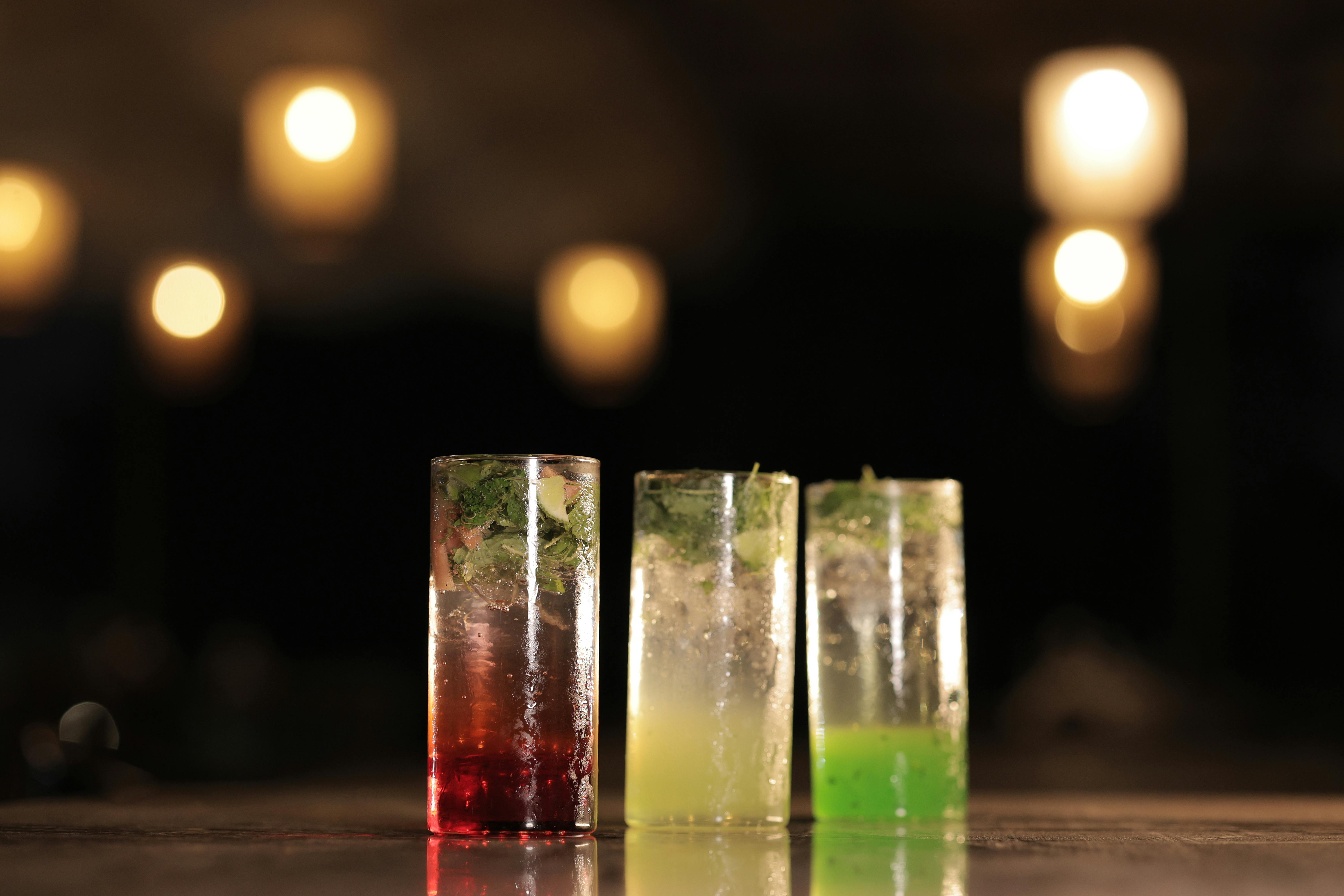
Recipes that include sparkling wine, soda or tonic almost always add the carbonated element last. The reason is that shaking destroys exactly the property the ingredient was chosen for.
What carbonation is holding onto
Carbon dioxide stays in a drink because it is dissolved under pressure and kept cold. The gas sits in an unstable arrangement that is constantly trying to escape.
Escape requires a nucleation site, a rough surface or existing bubble on which gas can gather. Left undisturbed, a sealed cold liquid holds its carbonation for a long time.
Agitation supplies nucleation sites in enormous numbers. Shaking with ice creates turbulence and surface area at once, which is the fastest way to strip a drink of its gas.
Why the pressure release is also a hazard
Sealing a carbonated liquid inside a shaker traps expanding gas in a fixed volume. Pressure builds quickly, particularly if the liquid was not thoroughly chilled beforehand.
The tin can separate under that pressure, and it separates in the direction of least resistance rather than the one the bartender is expecting.
This is why bar training treats a carbonated shake as an error rather than a stylistic choice. The practical risk arrives before the flavor problem does.
How the build order solves it
The standard approach is to shake or stir everything else, strain into the serving glass, and top with the carbonated component afterward.
Adding the sparkling element down the side of a tilted glass, or over the back of a spoon, reduces turbulence at the moment of contact and preserves more of the gas.
A single gentle lift with a spoon is usually enough to integrate the layers. Stirring vigorously at this stage undoes the care taken during the pour.
Why temperature does most of the work
Cold liquid holds dissolved gas far more readily than warm liquid. Soda stored at room temperature loses much of its carbonation the moment it hits the glass.
Bars that care about fizz keep mixers refrigerated and chill the glassware, because every warm surface the drink touches costs part of the effect.
Ice matters too. A glass packed with large, hard cubes releases less gas than one filled with small wet ice already melting at the surface.
Where forced carbonation changes the rules
Some bars carbonate the finished cocktail itself rather than adding a sparkling ingredient, chilling the mixture and pressurizing it inside a sealed vessel.
That approach requires the drink to be clear and free of pulp, since suspended particles act as nucleation sites and cause the batch to foam over on opening.
It also fixes dilution in advance, because no ice remains to melt in the glass. The recipe has to be written with the water already accounted for.